
Ashtabula County Court Records After Arrest
After an arrest in Ashtabula County, the jail booking record and the court case record are separate records. The jail side shows custody or commitment information. The court side shows the charges filed with the court, the hearings that follow, bond orders, warrant entries, pleas, and dispositions. The formal charge in court can differ from the intake or arrest charge because the prosecutor may file only some counts, amend a count, reduce a count, dismiss a count, or decline to proceed on a reported arrest offense.
For custody and booking details, use Ashtabula County jail inmate records. For booking photos, use Ashtabula County jail mugshots. Court records after a jail arrest answer a different question: what case opened, what the state filed, whether bond or a warrant was ordered, and how each charge ended. That distinction matters when a jail hold is recent, when a felony begins in a lower court for a preliminary hearing, or when a final felony disposition later appears in Common Pleas Court.
Find Ashtabula County Court Records
The county's official Court Records Search page routes users to the Ashtabula court e-services portal. The CourtView/e-services portal is the main public route for searching docket entries and case information maintained for the Ashtabula County Clerk of Courts, Eastern Area Court, and Western Area Court. The CourtView public notice warns that filings and judicial actions may not appear at once, so a new arrest may have a delay before the case record is visible.
The CourtView notice also has hard date limits. Ashtabula County Clerk of Courts records before May 1993 are not available through CourtView. Eastern Area Court and Western Area Court records before January 1995 are not available there. For missing or older court records after an arrest, call the office tied to the case: Clerk of Courts at 440-576-3637, Eastern Area Court at 440-576-3617, or Western Area Court at 440-466-1184.
The captured court e-services entry point shows the public portal used for Ashtabula County case lookup.
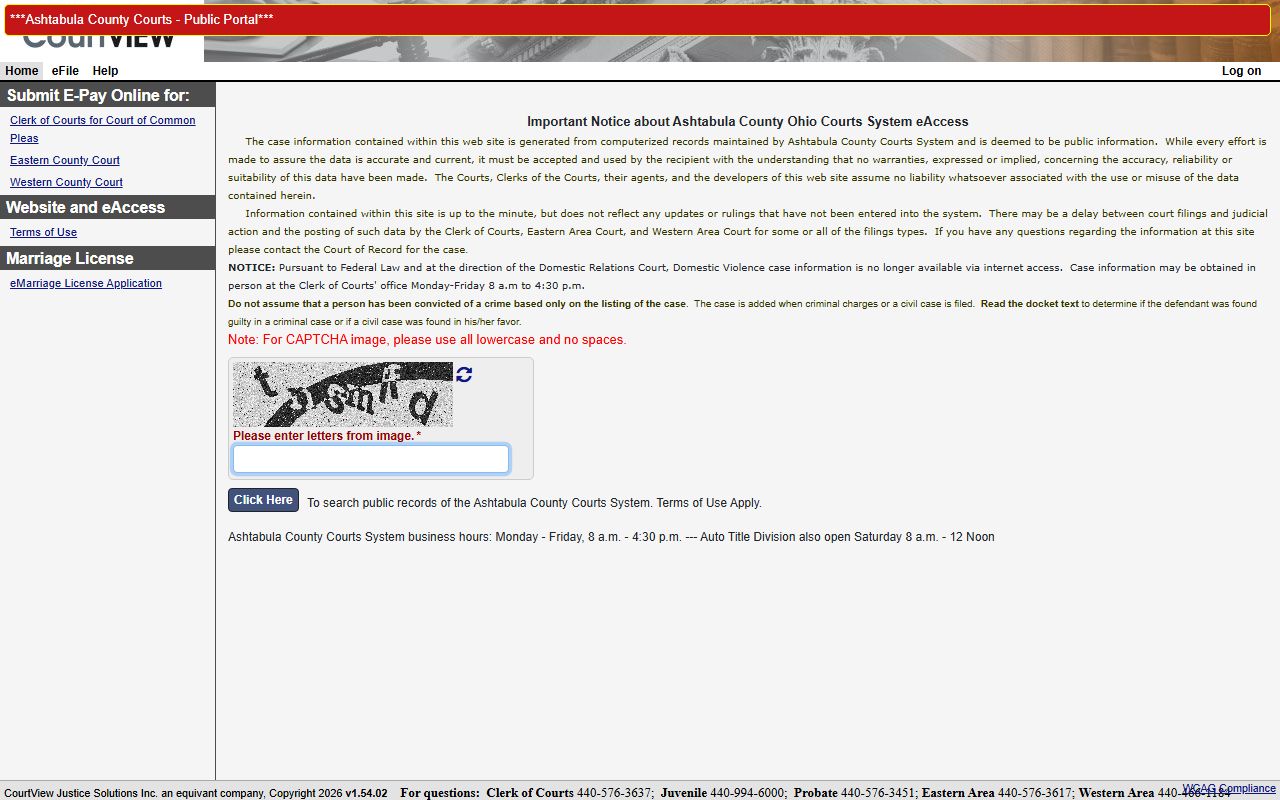
Because the portal is a JavaScript and Wicket application, static inspection did not expose a complete field list, so the practical search terms matter more than a fixed form inventory.
| Search Field | Static Finding | Practical Use |
|---|---|---|
| Defendant name | Field not exposed in static inspection | Use full name, and try spelling variants when a case is new. |
| Case number | Field not exposed in static inspection | Use when a docket number appears on bond papers, notices, or clerk letters. |
| Court | Field not exposed in static inspection | Check the likely municipal, area, or Common Pleas court for the case type. |
| Date | Field not exposed in static inspection | Use arrest, filing, hearing, or disposition dates when the portal allows narrowing. |
Ashtabula County Arrest Court Path
The Ashtabula Municipal Court criminal page is important for arrests in the City of Ashtabula, Ashtabula Township, Plymouth Township, and Saybrook Township. Its criminal division phone is 440-990-2263. The court states that misdemeanor cases carrying up to 12 months in jail and up to a $1,000 fine are heard there. Felony cases can be filed there for preliminary hearings only.
A preliminary hearing is a probable-cause hearing. It is not the final felony result. If probable cause is found, or if the felony is indicted, final disposition belongs in Ashtabula County Common Pleas Court. That is why court records after a jail arrest may begin in a municipal docket but end in Common Pleas. A name search may need both places, especially when the early case uses a complaint and the later case uses an indictment.
The municipal court's criminal and bond instructions also explain bond types and after-hours payment rules.
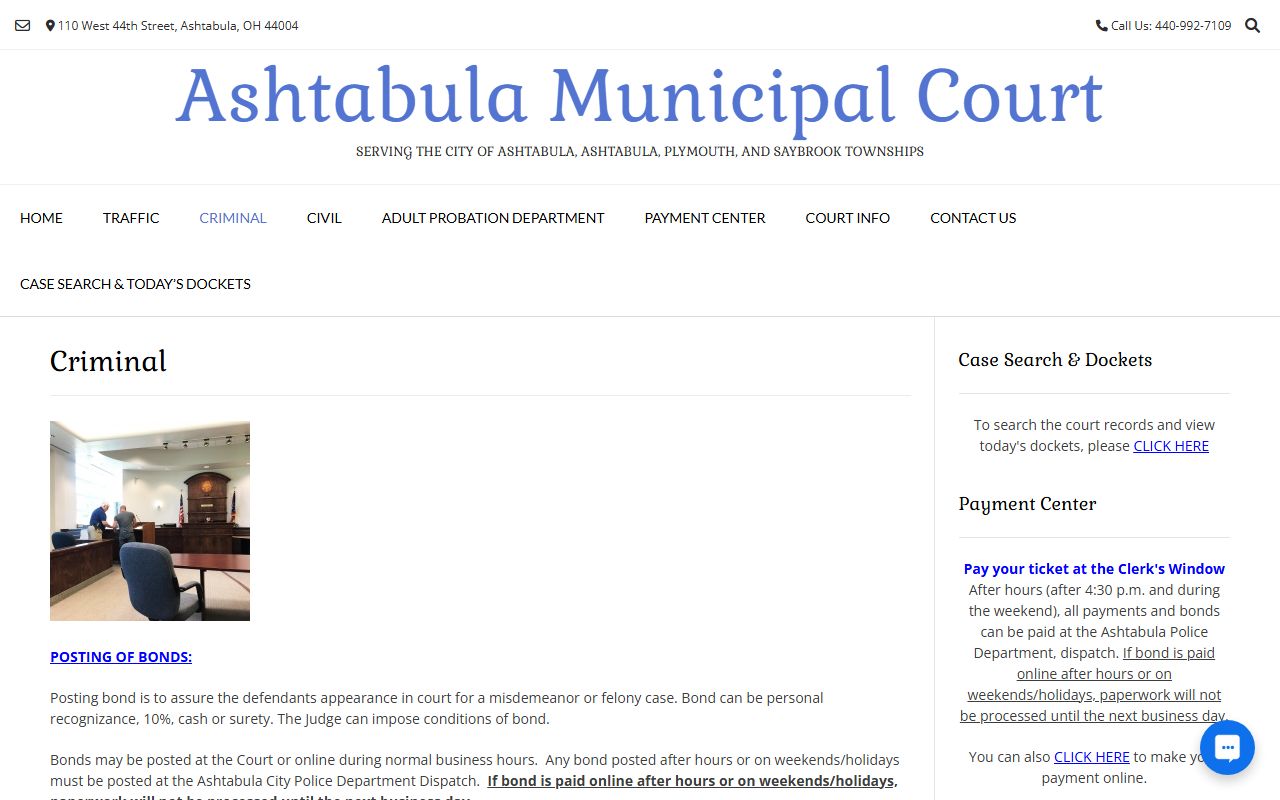
That local bond page is the best official source for how municipal court bond entries can affect release timing after an Ashtabula County arrest.
Ashtabula County Charging Documents
Once the booking process starts, the court record depends on a charging document. A complaint may start a misdemeanor case or an early felony case. An information is a prosecutor-filed charge used in some felony contexts. An indictment comes from a grand jury and is common in felony prosecution. The filing type helps explain why the same arrest can appear first as a municipal case and later as a Common Pleas case.
| Document | Who Uses It | What It Means After Arrest |
|---|---|---|
| Complaint | Law enforcement or prosecutor | Often starts the first court case after arrest, including misdemeanor cases and preliminary felony matters. |
| Information | Prosecutor | Formal prosecutor-filed accusation used when the law and case posture allow it. |
| Indictment | Grand jury | Felony charging document that can move the case into Common Pleas Court for final handling. |
Ohio counties use a Prosecuting Attorney, not a district attorney. The Ashtabula County Prosecutor's Office is led by Prosecuting Attorney April R. Grabman. Its Criminal Division prosecutes felony charges in the county's Courts of Common Pleas, provides legal assistance to law enforcement, and helps prepare arrest and search warrants.
The county's Prosecutor Criminal Division page describes the felony role tied to Common Pleas Court.
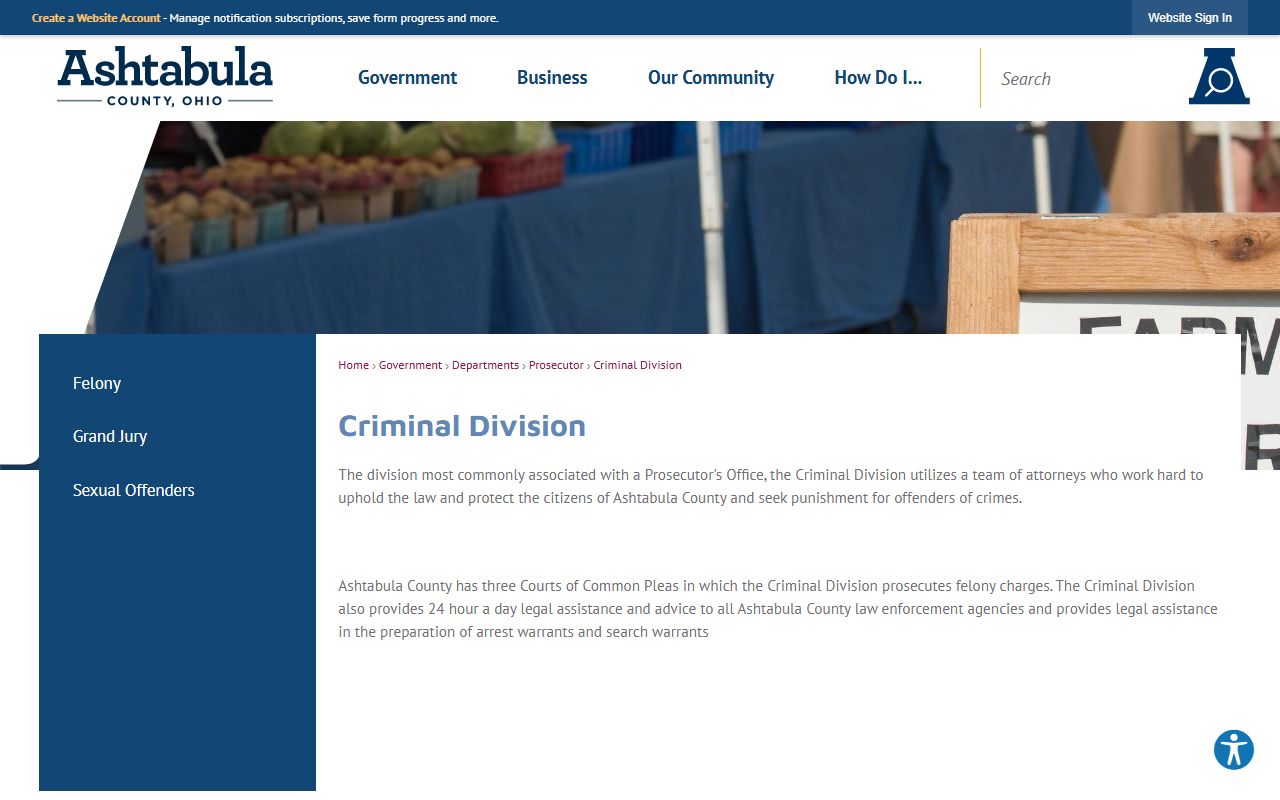
That prosecutor role is the bridge between an arrest report and the felony court record that may later control the final disposition.
Ashtabula County Charge Status
Charge status can change as the case moves. A docket may show pending charges soon after filing, then later show an amendment, reduction, dismissal, no bill, bindover, plea, verdict, or sentence. Do not treat a booking charge as the final court result. Court records after a jail arrest should be read by charge line and by disposition, since one count can end one way while another count remains open or ends by plea.
| Status | What It Means | Why It Matters |
|---|---|---|
| Pending | The charge is active and has not reached final disposition. | Court dates, bond orders, and warrant entries may still change. |
| Amended | The charge was changed by prosecutor or court action. | The filed charge may no longer match the arrest or booking language. |
| Reduced | The charge moved to a lesser offense. | Penalty range and record meaning may change. |
| Dismissed | The charge ended without conviction on that count. | A dismissal is not the same as a conviction. |
| No bill | The grand jury did not indict. | A felony path may stop or be revised. |
| Bound over | A preliminary felony matter moved to Common Pleas. | Search for a later Common Pleas docket. |
Bond After Ashtabula County Arrest
Bond is used to assure the defendant's appearance in court. The Ashtabula Municipal Court lists personal recognizance, 10%, cash, and surety bonds, and states that a judge can impose bond conditions. During normal business hours, bonds may be posted at the court or online. After hours, weekends, and holidays, bonds must be posted at Ashtabula Police Department dispatch. If an online bond is paid after hours, on a weekend, or on a holiday, the paperwork will not be processed until the next business day.
| Bond Type | Local Meaning |
|---|---|
| Personal recognizance | The defendant signs a promise to appear. Failure to appear can trigger jail time, a fine, bond liability, and a warrant. |
| 10% bond | The defendant posts 10% of the bond amount. Returned funds may be reduced and applied to fines or costs. |
| Cash or surety | The full amount may be posted in cash, or a professional surety may be used. The court does not recommend bondsmen. |
| No-bond or hold | Money alone will not cause release when a court, agency hold, detainer, or another case blocks release. |
Bond entries in court records should be reconciled with jail information before payment. A person may have a warrant from another court, a probation or parole detainer, an ICE detainer, a state or federal hold, or a new bond set after failure to appear. A posted bond in one Ashtabula County court case may not clear every custody reason.
Warrants in Ashtabula County Records
No official Ashtabula County sheriff public active-warrant search was located in the research. Court records are the main public place to look for warrant context tied to a case. Search the docket for failure to appear, bond forfeiture, bench warrant, capias, recall, or quash entries. For Ashtabula city and township cases, the municipal criminal division can be reached at 440-990-2263.
The CourtView notice gives clerk contacts for older or unclear cases: Clerk of Courts 440-576-3637, Eastern Area Court 440-576-3617, and Western Area Court 440-466-1184. Sheriff's dispatch and records contacts can route custody or warrant questions, but a person who believes a warrant may be active should call the court or an attorney for instructions. Active investigations, sealed records, and protected warrant material may not be released through public-records channels.
Note: Failure to appear can cause bond forfeiture, a bench warrant, and a new bond, even when the original charge has not been resolved.
Charges Versus Convictions
Being arrested and charged is not the same as being convicted. A charge is an accusation filed in court. A conviction is the result of a guilty plea, no-contest finding where guilt is found, jury verdict, or judge finding that resolves the charge against the defendant. When court records after a jail arrest are used to understand risk, history, or case status, the disposition column matters as much as the charge name.
| Point of Comparison | Charge | Conviction |
|---|---|---|
| Stage | Accusation filed after arrest or investigation | Final finding or plea on a charge |
| Proof level | Based on filing standards such as probable cause | Requires proof beyond a reasonable doubt or a valid plea |
| Can change | Can be amended, reduced, dismissed, or no-billed | Can affect sentencing, supervision, and future record access |
| Public meaning | Shows what was alleged | Shows what was legally resolved against the person |
Sealed or Expunged Court Records
Ohio Revised Code 2953.32 sets procedures for sealing and expungement of eligible conviction and bail-forfeiture records. In plain terms, sealing limits public access to a record, while expungement is a stronger form of record relief where the record is treated as erased or destroyed under the statute. Eligibility depends on the offense, outcome, timing, prior record, and court order.
| Record Relief | Public Access Effect | Ashtabula County Court Record Point |
|---|---|---|
| Sealed | Hidden from most public case searches | The public docket may no longer show the case or may show limited information. |
| Expunged | Record relief with stronger removal treatment under Ohio law | Access is more limited, but the exact effect depends on the court order and statute. |
| Not eligible or not ordered | Public access may remain | A dismissal or old case does not vanish from public search unless the court grants relief. |
Sealing or expungement is a court process, not a jail roster edit. If an Ashtabula County arrest led to a charge that was dismissed, reduced, no-billed, or resolved long ago, the clerk can explain what the docket shows, but legal advice should come from an attorney. Public-records staff may withhold or redact records when state or federal law requires it.
Older Ashtabula County Court Records
Older and restricted records need a different path. CourtView does not include Ashtabula County Clerk of Courts records before May 1993 or Eastern and Western Area Court records before January 1995. Juvenile matters, sealed cases, protected victim information, active investigation material, and some warrant records may also be limited. If a search does not return a record after an arrest, use the clerk numbers from the CourtView notice and ask which office maintains the case file.
For broader record access, Ohio's Public Records Act applies to public-office records unless an exemption allows withholding or redaction. The county public-records process allows verbal requests, inspection without charge, and electronic transmission when available, but the request should be sent to the office that maintains the record. Court records, jail records, sheriff records, and prosecutor records are not one file kept in one place.
Important: Court records after an arrest are public-record references, not consumer reports for employment, tenant screening, credit, insurance, or similar FCRA-covered decisions.